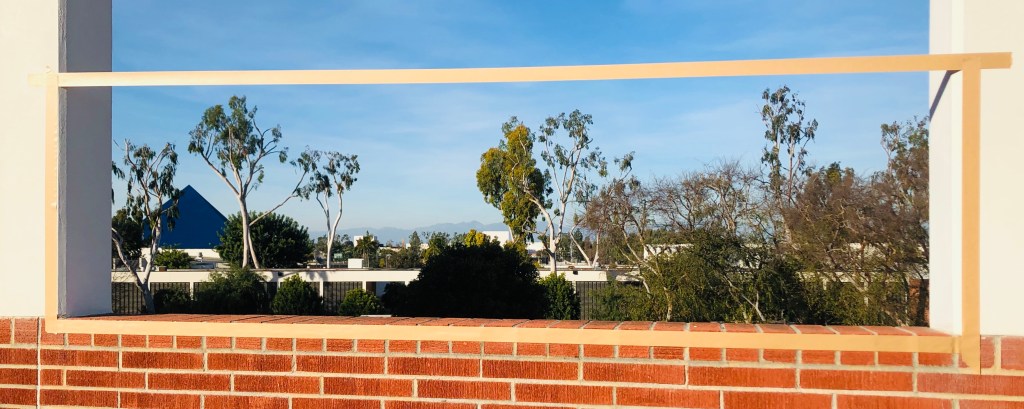
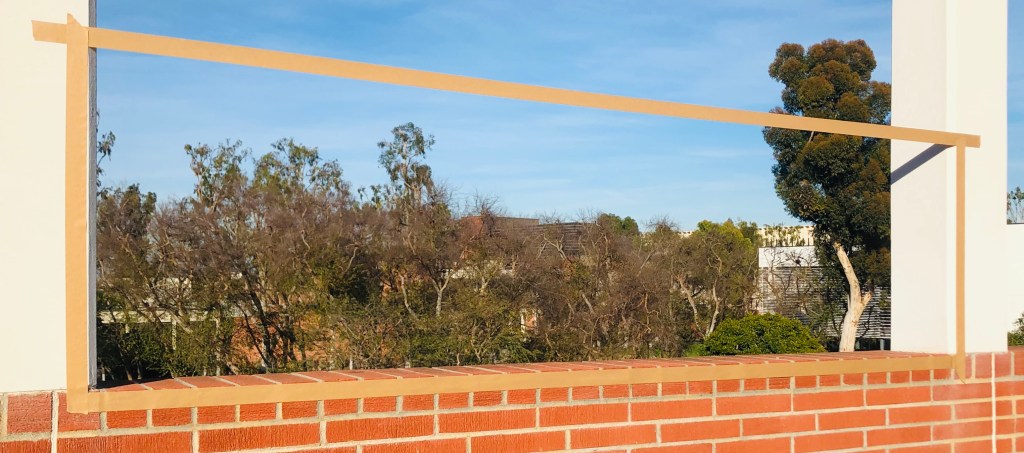
This week, we had the task of a curator to find art in our campus. Armed with rolls of tape and a group of fellow “art curators,” we marched the campus to create a frame around works of art. The piece we settled on as a group was a large piece. Depending on the viewing angle, (like the two examples above) the piece could have been monochrome or brightly colored. From most angles, the piece is textured and dense. The elongated length of the frame restricts the point of view so that the viewer sees the piece as a horizon rather than a picture as most works of art are presented. Through most views, the contents are dense in lines as the frame helps exclude the empty sky above.
The art is pleasant and calming. For CSULB students and faculty, who are most likely the viewers, the piece is relatable and familiar almost adding a reminiscent quality. This piece of art is meant to provoke the viewer to see something different every time they see the art. From one view, you see the group of trees bunched together and the engineering buildings behind. From another view you see the buildings and the famous CSULB pyramid gently in the background. Like all art, it is subjective depending on what you see, how you see it, what you notice, and how you perceive it. In this piece, you get a different experience every time you see it and that experience may be different from someone standing directly next to you viewing it as well.
Before we came along and created a frame with the scotch tape, the view was not “art” per se. By creating a frame and forcing people to see the view through a frame, we made it art that was meant to be viewed and pondered about. As was the case for most, if not all, of the groups, the subjects were not art until we encased them in the scotch tape frames. The art also did not necessarily depend on the object or subject, but in the combination of tentative thinking and the fact that the object was framed. When the viewer attempts to ponder the meaning of what is within the frame, then the subject becomes art. Some object lent themselves to become viewed as art. One group, for example, framed a small plant growing from between two strong concrete slabs. Something like this sends a strong message of beauty growing in the face of difficulty and challenge. Something like that plant may lend itself more readily to the idea of being art rather than another object like another group’s framing of a bike rack pole structure. However, as we saw many different objects and views were classified as art.
There are so many different types of art. From 2D to 3D and abstract to realism, there is a type of art for everyone. In our class, some people chose views, which represented more of a 2D-style piece and others chose 3D objects. One group’s art caught my attention in particular. The group that framed the escalators of CSULB created a particularly intriguing piece. The movement of students and passer-bys walking through added a whole new level of interest. Pieces like this show just how different art can be in each person’s experience. For someone watching the escalators during rush hour, they may see the business of peoples’ day to day and the distraction in everyone’s purpose of getting where they need to go. However, for someone watching the escalators in a calm moment, they may ponder about each person individually rather than the hoard passing through and the general implications. This activity showed us how different art can be from one piece to another.
 Yazmin's Blog